Read More......


W. Marshall Leach, Jr., Professor
Georgia Institute of Technology
School of Electrical and Computer Engineering
Atlanta, GA 30332-0250
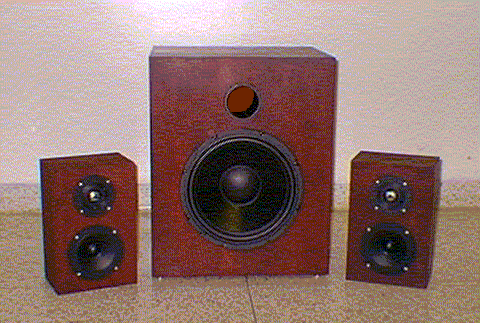
 In the spring of 1999, mechanical engineering student Chris Germann asked me if he could receive special problem credit for the design and construction of a loudspeaker system. I approved his project and agreed to be his advisor. The system that Chris designed is described on this page. It is a three way system with a dual voice coil woofer in a center channel enclosure and two satellite speakers.
You can see a picture of Chris's system here.
The woofer that we chose is the MCM 55-1465 12-inch dual voice coil woofer. It is available from MCM Electronics. This is a very high quality driver for the price. With the two voice coils connected in parallel, the small-signal parameters that we measured are as follows:
We decided to use a vented-box enclosure for the woofer. For its design, we assumed the box quality factor QL = 7. From the QL = 7 design chart, the vented-box design data for QTS = 0.326 is as follows:
With the above data, the woofer enclosure parameters can be calculated as follows:
In the calculations, we neglected the effect of the resistance of the inductors in the crossover network on the woofer parameters. This resistance has the effect of increasing the effective quality factor of the woofer, which would require a bigger box. One of the criteria that we decided on at the start was a woofer box volume not greater than about 2 cubic feet. A higher quality factor would result in a bigger box, which we did not want. With the box design described here, the effect of the crossover network resistance is to cause a slight peak lift in the lowest bass frequencies, an effect that we considered desirable.
For the vent, we chose a tube with a 3-inch internal diameter. For a Helmholtz frequency of 34 Hz, the vent length calculates to be 5-1/2 inches long.
The drivers that we chose for the midrange and the tweeter are as follows:
Both of these are very high quality drivers. The midrange is one of the best that I have tested, especially when it is put into a closed box enclosure that is large enough to obtain a low resonance frequency. Two each of these drivers are required for the system.
The box designs assume a wall thickness of 3/4". The woofer enclosure is braced internally with 1-1/2" by 1-1/2" bracing. Cabinet makers often will tell you that they can make boxes that are just as sturdy without the bracing, but don't believe it. The sattelite enclosures have 3/4" by 3/4" bracing around the back only. The bracing for all three boxes is recessed from the back by 3/4" + 1/16" = 13/16". The extra 1/16" is for the thickness of the foam tape around the back bracing that is used for an air-tight seal when the back panel is screwed to the bracing. The enclosures and internal bracings are described in the following figures:
To minimize splintering around the edges when the final panel cuts are made, use a utility knife and a straight edge to make the first cut into the wood. Then use the saw to make the final cut. The hole diameters labeled on the figures for the drivers and the port are from Chris's report. These should be checked to be sure they are correct before cutting the holes.
The woofer enclosure dimensions account for the internal volume occupied by the driver, the bracing, and the vent tube. The ratios of its internal dimensions are 0.8 by 1.0 by 1.25. These are one of the two optimum ratios for a woofer enclosure. (The others are 0.6 by 1.0 by 1.6.) The enclosure should be lined with 1-inch thick fiberglass. Do not cover the back of the woofer or the port tube with fiberglass. The sattelite enclosures should be filled with fiberglass. It should not be compressed. You can purchase the fiberglass from Radio Shack. It should not take more than 2 bags for the 3 enclosures.
I recommend building the enclosures with 3/4" veneered plywood. After the panels are cut, they can be nailed together on the outside with thin finishing nails. Corner clamps are useful to hold the panels together at a 90 degree angle when nailing them together. The nails should be counter sinked and the holes filled with wood filler. The internal bracing is screwed from the inside of the boxes. Holes for the screws should be drilled in the bracing first. Then apply glue to the bracing and screw it to the insides of the box with wood screws or dry-wall screws. (I prefer the latter.) C clamps should be used to hold the bracing to the box while putting the screws in. It is best not to remove the C clamps until the glue has set up. The specified length of each bracing piece has been reduced by 1/16" to make sure it will fit the box without being forced. Any gaps can be filled with caulk after the the glue has set up.
After the glue has set up, the inside joints can be sealed with glue or caulk to prevent any possible air leaks. I prefer clear silicon rubber caulk (not the paintable kind). Caulk should also be applied around the vent tube inside the box. The drivers can be screwed to the front panel with wood screws or dry-wall screws. Because dry-wall screws have a black color, I prefer them. Do not mount the drivers from the inside of the box.
You can see the circuit diagram for the crossover network for one channel here.
Note that the midrange and tweeter are both connected with reversed polarity to the crossover network. This is necessary to prevent phase cancellation between the woofer and the midrange at the crossover frequency. The resistors in the midrange and tweeter networks form L-pad attenuators to equalize the on-axis pressure sensitivities of the drivers. Without these resistors, the highs would be much too bright. I recommend using printed circuit boards for the crossover networks. Most of the suppliers of loudspeaker drivers sell these. You may not find holes on the printed circuit boards for the L-pad resistors in the midrange and tweeter networks, but they can be easily added. Do not use any pre-made crossover networks.
To provide access to the inside of the boxes, the rear panels are not glued in place. For an air tight seal, put closed-cell foam weather stripping (sometimes called camper tape) around the bracing that the rear panels are screwed to. I recommend the 3/16" thick by 1-1/4" wide self-adhesive, closed-cell vinyl foam weatherstrip tape made by Macklanburg Duncan Co., Dennis, or ACE Hardware. (The ACE part number is 85017.) When the screws for the rear panel are installed, they should be tightened just enough to compress the weather-stripping by about 1/8" so that the rear panel will fit flush.
Here are some links to suppliers of loudspeaker components:
A wood working shop that built speakers for two students in the Spring 2000 semester is Atlanta Wood Trends, 404-696-7434. The man who runs the shop is Scott LaPointe. The man who did the job is named Jim. The cost for was $125 for two satellite boxes and one woofer box made of birch veneered plywood. If you have them make boxes for you, be sure to tell the worker that you want the bracing and that you want it cut from solid wood, not plywood. Also, have a written and signed contract before you make the down payment. When the students went to pick up their boxes, there seemed to be a misunderstanding over exactly what the deliverables were. A signed contract could have prevented this.
This page is not a publication of the Georgia Institute of Technology and the Georgia Institute of Technology has not edited or examined the content. The author of this page is solely responsible for the content. Copyright 1999. All rights reserved.


A651 The Signature Series by Vance Dickason
| |||||||||


A652 The Signature Series by Vance Dickason | ||
| Crossover parts | ||
| Inductors L1= 0.68mH, 0.17 Ohms, 14g air-core L2=0.47mH, 0.13 Ohms, 14g air-core L3=0.33mH, 0.10 Ohms, 14g air-core Capacitors C1=10.0uF, polypropylene C2=5.1uF, polypropylene C3=24.0uF, polypropylene Resistors R1=5 Ohms, 10 Watts R2=1 Ohms, 10 Watts | ||
| Dimension of box | ||
| Internal Dimensions=24.875"x7.5"x9" External Dimensions=26.375"x9"x10.75" Front Baffle=1" MDF Sides/Top/Bottom=0.75" MDF Brace All Members= 0.75"x 0.75" Construction=Butt Joint | ||
| A652 The A652 is a 2-way design using two Audax HM170C0 6.5" woofers and a TW025M0 1" soft dome tweeter, mounted in the popular D'Apollito configuration with the tweeter placed between the two woofers. Using this technique produces a smoother vertical frequency response above and below the listening axis. This enclosure is computer optimized for a modified vented QB3 type of response yielding an F3 of about 53Hz. This volume provides a well damped group delay profile for bass detail and produces an output of 105dB, remaining linear down to 37Hz. The advantage of using the double 6.5" woofers in a 2-way speaker is higher efficiency and lower distortion in the lower frequencies. CROSSOVER DETAILS SPEAKER LOCATION CONSTRUCTION INSIGHTS |


 Postări
Comentarii
Postări
Comentarii